support this site

Showing posts with label drug delivery. Show all posts

Wednesday, March 10, 2010

Cowpea Mosaic Virus Delivers Drugs to Kill Cancer Cells

Ads : Nano Technology   Netbook    Technology News    Computer Software

Norwich BioScience Institutes have developed particles from the Cowpea mosaic virus can carry anti-cancer agents to cancer cells.

Materials View China - Cowpea Mosaic Virus Unmodified Empty Viruslike Particles Loaded with Metal and Metal Oxide

Empty (devoid of RNA) viruslike particles (eVLPs) of Cowpea mosaic virus can now be obtained readily. CPMV can encapsulate, within the protein capsid, cobalt or iron oxide by environmentally benign processes. The external surface also remains amenable to chemical modification. The development of eVLPs for targeted delivery of therapeutic agents is now a reality.

7 pagse of supplemental material

In 2008, there was the first work on using the tobacco mosaic virus to deliver siRNA to cells

Tobacco mosaic virus is like a 18-nanometer wide straw, which can hold gene silencing RNA.

“The speed with which you develop siRNA drugs is truly amazing,” said Stephen Hyde. “In the past, a traditional small molecule drug might take several years of intensive research effort by a large team of scientists to develop. Today, with siRNA technology, it is possible for a single researcher to develop a drug candidate in a few weeks.”

Block copolymer nanotemplating of tobacco mosaic and tobacco necrosis viruses (Nov 2008)

Joural of Virology -Interaction of the Tobacco Mosaic Virus Replicase Protein with a NAC Domain Transcription Factor Is Associated with the Suppression of Systemic Host Defenses (Oct 2009)


Advertising

Trading Futures
 
Nano Technology
 
Netbook     Technology News
 
Computer Software
   
Future Predictions

Thank You


Tuesday, April 29, 2008

Folded up micrometer-scale 'voxels' for drug delivery


After starting the folds using magnetic forces, the structure is sealed using capillary action.


USC researchers have made pyramid structures that are 40 micrometers on each side

Part one is the creation of flat patterns, origami, of exactly the fold up shapes familiar to kindergarten children making paper pyramids, cubes or other solids, except that these are as small 40 micrometers (µm) on a side. (1 inch = 25,400 µm)

Instead of paper, the USC researchers created the patterns in polysilicon sitting on top of a thin film of gold, using a well-established commercial silicon wafer process called PolyMUMPs. The next step was clearing the polysilicon off the hinge areas by etching.

When the blanks were later electrocoated with permalloy to make them magnetic, the photomask used left hinge areas uncoated, to make sure they were the places that folded.

Then the folding had to be accomplished. First the researchers bent the hinges by application of magnetic force to the permalloy. Water pressure and capillary forces generated by submerging the tiny blanks in water, and drying them off did the final folding into shape.

The experiments spend considerable time comparing various methods of controlling the closure effects of water drying with simple flaps designed to close over each other to form "envelops," the directing water from different directions sequence the closing. Varying the time of trying could produce tighter seams.

Nanodiamonds 100 times cheaper, used to track cells in the body and deliver chemotherapy drugs

Taiwanese scientists have found a way to slash the cost of making the diamond chips by around 100 times.

Nanodiamond's fluorescent properties could be used to track cells moving through the body. And, last year, researchers showed they could safely deliver chemotherapy drugs.

Cheaper alternatives to nanodiamonds, such as fluorescent dyes or small chunks of semiconductor known as quantum dots, are in use already. The diamonds, though, are less prone to blinking on and off than fluorescent dyes, and are not toxic to cells, unlike quantum dots.

FNDs are usually made by firing a high-energy electron beam into commercially available diamond powder and heating it up to 800 °C. Huan-Cheng Chang and colleagues at Academia Sinica in Taipei shoot a much less intense, and hence cheaper, beam of helium ions at diamond powder to make FNDs of the same quality.

Chang's team could track the movement of a single fluorescent nanodiamond within a cell for over 3 minutes.

The researchers have also explored other applications for their cheap diamonds, such as using them to monitor stem cells in developing tissue, or to carry drugs into cells.

"In particular, we have demonstrated that FNDs are able to interact with plasmid DNA and to deliver different genes into cultured human cells," Chang told New Scientist. That could be used for gene therapy, or DNA vaccines.

Chang and his colleagues have set up a commercial operation selling their nanodiamonds and are working on making them even smaller and to fluoresce more brightly.

The cheaper diamond chips need to be made smaller, though, if they are to perform well as markers to reveal the inner workings of cells, he adds.

Friday, April 18, 2008

Tiny Magnets for more effective Gene Therapy targeting for cancer, arthritis, heart disease and more

The technique involves inserting nanomagnets into monocytes - a type of white blood cell used to carry gene therapy - and injecting the cells into the bloodstream. The researchers then placed a small magnet over the tumour to create a magnetic field and found that this attracted many more monocytes into the tumour.

This new technique could also be used to help deliver therapeutic genes in other diseases like arthritic joints or ischemic heart tissue.

Though the concept of magnetic targeting for drug and gene delivery has been around for decades, major technical hurdles have prevented its translation into a clinical therapy. By harnessing and enhancing the monocytes' innate targeting abilities, this technique offers great potential to overcome some of these barriers and bring the technology closer to the clinic.

The team are now looking at how effective magnetic targeting is at delivering a variety of different cancer-fighting genes, including ones which could stop the spread of tumours to other parts of the body.

Friday, March 21, 2008

Lipid Polymer Nanocontainers with controlled permeability


From Nano Letters, "Biofunctionalized Lipid−Polymer Hybrid Nanocontainers with Controlled Permeability"

We have successfully developed, for the first time, a novel polymer–lipid hybrid nanocontainer with controlled permeability functionality. The nanocontainer is made by nanofabricating holes with desired dimensions in an impermeable polymer scaffold by focused ion beam drilling and sealing them with lipid bilayers containing remote-controlled pore-forming channel proteins. This system allows exchange of solutions only after channel activation at will to form temporary pores in the container. Potential applications are foreseen in bionanosensors, nanoreactors, nanomedicine, and triggered delivery.


FURTHER READING
Alma Dudia's PhD thesis "Nanofabricated biohybrid structures for controlled drug delivery"

Nanoparticle synthesis techniques could grow functional devices out of solution

Nanowerk reports on an important research direction in nanoparticle synthesis is the expansion from single-component nanoparticles to hybrid nanostructures that possess two or more functional properties thanks to the integration of different materials.

In their research, Zeng and Sun have been trying to find a cost-effective approach to hierarchically assemble nanoscale building blocks for functional materials and devices. "In the past, this has been largely done by complicated microfabrication techniques involving multi-step lithography" explains Zeng. "The core of our work is the development of a general route for synthesizing multi-component, hybrid nanostructures where different nanoscale building blocks are directly grown onto one another to realize materials with multifunctionality. We envision that one day scientists will be able to grow completely functional sensors or even computer chips out of the solution phase. Our work is one small step towards realizing this goal."

Using their general synthesis approach, the two groups have produced a rather comprehensive list of hybrid materials that can be grouped into four classes: magnetic-metallic, magnetic-semiconductor, semiconductor-metallic, and magnetic-metallic-semiconductor.

The range of applications for these multicomponent nanoparticles is wide. For instance, they can be used as multi-modal bio-markers combining the functionalities of imaging, guided drug delivery and hyperthermia. Integrating different material properties at the nanoscale may also provide new opportunities for discovering enhanced or entirely novel material properties. Zeng uses the example of a ferroelectric-ferromagnetic multicomponent structure that could be used for electric field control of magnetism. "Such new functionality may one day allow new device concepts in nanoelectronics" he says.


Three sets of challenges before we can see large-scale practical applications:
1) gaining a fundamental understanding of the chemistry and materials science issues involved, so that hybrid structures can be designed with a high degree of control;

2) gaining a fundamental understanding of the interactions at the nanoscale between different components, so that the novel physical properties that may originate from such coupling can be predicted and exploited; and

3) finally, the controlled assembly of such hybrid nanoscale building blocks into bulk materials

Monday, December 10, 2007

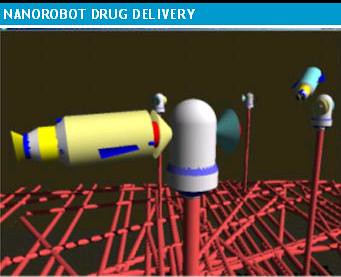
Nanorobot drug delivery

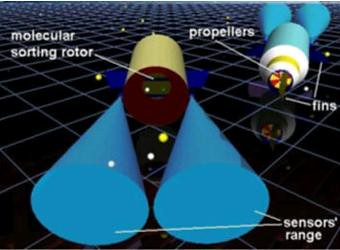
Adriano Cavalcanti is CEO and chairman of CAN Center for Automation in Nanobiotech. Adriano and his coleagues have proposed a nanorobot platform should enable patient pervasive monitoring, and details are given in prognosis with nanorobots application for intracranial treatments. This integrated system also points towards precise diagnosis and smart drug delivery for cancer therapy.


nanorobot for nanomedicine drug delivery


Simulated nanorobot for drug delivery

Fully operational nanorobots for biomedical instrumentation should be achieved as a result of nanobioelectronics and proteomics integration. The proposed platform should enable patient pervasive monitoring, and details are given in prognosis with nanorobots application for intracranial treatments. This integrated system also points towards precise diagnosis and smart drug delivery for cancer therapy.

The methodologies and the implemented 3D simulation described in our study served as a test bed for molecular machine prototyping. The numerical analysis and advanced simulations provided a better understanding on how nanorobots should interact inside the human body. Hence, based on such information, we have proposed the innovative hardware architecture with a nanorobot model for use in common medical applications. The nanorobot takes chemical and thermal gradient changes as interaction choices for in vivo treatments. The use of mobile phones with RF is adopted in this platform as the most effective approach for control upload, helping to interface nanorobots communication and energy supply.

The next steps in our work can be defined as follows: (a) model manufacturing with CNT-CMOS biochip integration; (b) laboratory studies for in vivo tests; and (c) commercialization. The pipeline for development in the medical sector typically requires research and efforts to get new ideas out of laboratories and into the marketplace


FURTHER READING
Nanorobot design website

They have written many papers on this work. Robert Freitas is involved in some of them.

Nanorobot architecture for medical target identification.

The nanorobot interaction with the described workspace shows how time actuation is improved based on sensor capabilities. Therefore, our work addresses the control and the architecture design for developing practical molecular machines. Advances in nanotechnology are enabling manufacturing nanosensors and actuators through nanobioelectronics and biologically inspired devices. Analysis of integrated system modeling is one important aspect for supporting nanotechnology in the fast development towards one of the most challenging new fields of science: molecular machines. The use of 3D simulation can provide interactive tools for addressing nanorobot choices on sensing, hardware architecture design, manufacturing approaches, and control methodology investigation.


Earlier work was with CMOS versions of small robots

Hardware architecture for nanorobots

Freitas' nanomedicine site

Center for Automation in Nanobiotech website

Monday, November 12, 2007

Toward cancer drugs that penetrate 10 times deeper into the brain

A new drug-delivery system for cancer of the brain — one of the most difficult cancers to treat — has the potential to carry anticancer drugs 10 times deeper into tumors than conventional medications, researchers in Connecticut and New York report.

In the new study, Mark Saltzman and colleagues showed that linking the anticancer drug campothecin (CPT) to the polymer polyethylene glycol (PEG), increased drug diffusion to more than a centimeter from the implant site.

They also identified a promising CPT-PET compound that could deliver 11 times more medication to the tumor than the plain drug alone. For patients, those advantages could substantially improve chances for successful treatment, the researchers indicate.

Friday, October 12, 2007

Nanodiamonds delivery chemotherapy drugs without negative side effects

Northwestern University researchers have shown that nanodiamonds -- much like the carbon structure as that of a sparkling 14 karat diamond but on a much smaller scale -- are very effective at delivering chemotherapy drugs to cells without the negative effects associated with current drug delivery agents.

Their study, published online by the journal Nano Letters, is the first to demonstrate the use of nanodiamonds, a new class of nanomaterials, in biomedicine. In addition to delivering cancer drugs, the model could be used for other applications, such as fighting tuberculosis or viral infections, say the researchers.

Nanodiamonds promise to play a significant role in improving cancer treatment by limiting uncontrolled exposure of toxic drugs to the body. The research team reports that aggregated clusters of nanodiamonds were shown to be ideal for carrying a chemotherapy drug and shielding it from normal cells so as not to kill them, releasing the drug slowly only after it reached its cellular target.

To make the material effective, Ho and his colleagues manipulated single nanodiamonds, each only two nanometers in diameter, to form aggregated clusters of nanodiamonds, ranging from 50 to 100 nanometers in diameter. The drug, loaded onto the surface of the individual diamonds, is not active when the nanodiamonds are aggregated; it only becomes active when the cluster reaches its target, breaks apart and slowly releases the drug. (With a diameter of two to eight nanometers, hundreds of thousands of diamonds could fit onto the head of a pin.)

“The nanodiamond cluster provides a powerful release in a localized place -- an effective but less toxic delivery method,” said co-author Eric Pierstorff, a molecular biologist and post-doctoral fellow in Ho’s research group. Because of the large amount of available surface area, the clusters can carry a large amount of drug, nearly five times the amount of drug carried by conventional materials.

Liposomes and polymersomes, both spherical nanoparticles, currently are used for drug delivery. While effective, they are essentially hollow spheres loaded with an active drug ready to kill any cells, even healthy cells that are encountered as they travel to their target. Liposomes and polymersomes also are very large, about 100 times the size of nanodiamonds -- SUVs compared to the nimble nanodiamond clusters that can circulate throughout the body and penetrate cell membranes more easily.

Unlike many of the emerging nanoparticles, nanodiamonds are soluble in water, making them clinically important. “Five years ago while working in Japan, I first encountered nanodiamonds and saw it was a very soluble material,” said materials scientist Houjin Huang, lead author of the paper and also a post-doctoral fellow in Ho’s group. “I thought nanodiamonds might be useful in electronics, but I didn’t find any applications. Then I moved to Northwestern to join Dean and his team because they are capable of engineering a broad range of devices and materials that interface well with biological tissue. Here I’ve focused on using nanodiamonds for biomedical applications, where we’ve found success.

“Nanodiamonds are very special,” said Huang. “They are extremely stable, and you can do a lot of chemistry on the surface, to further functionalize them for targeting purposes. In addition to functionality, they also offer safety -- the first priority to consider for clinical purposes. It’s very rare to have a nanomaterial that offers both.”

“It’s about optimizing the advantages of a material,” said Ho, a member of the Lurie Cancer Center. “Our team was the first to forge this area -- applying nanodiamonds to drug delivery. We’ve talked to a lot of clinicians and described nanodiamonds and what they can do. I ask, ‘Is that useful to you?’ They reply, ‘Yes, by all means.’”

For their study, Ho and his team used living murine macrophage cells, human colorectal carcinoma cells and doxorubicin hydrochloride, a widely used chemotherapy drug. The drug was successfully loaded onto the nanodiamond clusters, which efficiently ferried the drug inside the cells. Once inside, the clusters broke up and slowly released the drug.

In the genetic studies, the researchers exposed cells to the bare nanodiamonds (no drug was present) and analyzed three genes associated with inflammation and one gene for apoptosis, or cell death, to see how the cells reacted to the foreign material. Looking into the circuitry of the cell, they found no toxicity or inflammation long term and a lack of cell death. In fact, the cells grew well in the presence of the nanodiamond material.

Thursday, September 20, 2007

Launching nanoparticle drug delivery site

Here is the start of my site devoted to nanoparticle drug delivery. I am providing it as a service so that fewer people will need to buy overpriced market reports on the same subject. I will also launch several other sites on near term nanotechnology subjects. My main website on future technology with a significant focus on advanced nanotechnology is advancednano

The Drug delivery is a multi-billion dollar business. Some calculate it as a 9.8 billion business. Led by the strong growth of biotechnology drugs requiring novel delivery technologies, the injectable/implantable drug delivery market reached revenues of $9.8 billion in 2006

Nanotechnology in drug delivery

A drug delivery website

Drug delivery stocks

The 9th annual drug delivery symposium coming Dec 16-20, 2007 is only about $600 versus $5000 or more for some market reports

Advance Nanotech Singapore Pte. Ltd. owns 75% of Nano Solutions Limited (Imperial College, London) which is developing Nanovindex. Nanovindex is a nanoparticle-hydrogel composites for drug delivery.

From 2005, 10Q
Nanotechnologies have already begun to change the scale and methods of drug delivery and hold huge potential for future developments in this area. Nanotechnology can provide new formulations and routes for drug delivery that broaden their therapeutic potential enormously by allowing the delivery of new types of medicine to previously inaccessible sites in the body. Novel composites incorporating nanoparticles are particularly exciting for these applications. A key to gaining competitiveness within the market is to develop next generation composites which are extremely sensitive to a variety of environmental stimuli. NanoVindex aims to achieve this by utilising expertise in rational peptide design to incorporate specific pH, enzymes and temperature triggers within the composites enabling a new level of control over the release of encapsulated drugs.

Technology

NanoVindex is seeking to develop a platform technology of nanoparticle-hydrogel composites for tailored drug delivery applications. The development shall leverage the research of Imperial College London in rational design of self-assembling peptide systems, control over the nanoscale organic/inorganic interface, and physiologically responsive bio-nano materials. Revenues to drug delivery companies were $1.3bn in 2002 and projected to increase to $6.7bn by 2012. With the focus evermore on emerging nanotechnologies and the improvements these may offer over more conventional systems, the market for new nanotechnologies in drug delivery is poised to be a multi-billion dollar arena. These technologies have the potential to revolutionise the pharmaceutical industry.


FURTHER READING
Abstract on Hydrogel-Nanofiber Composite Systems For Drug Delivery

2003 patent, Composite hydrogel drug delivery systems

google search of hydrgel composites drug delivery

Google search on nanoparticle drug delivery

Other drug delivery market studies by Kalorama